
Chapters
Learn step by step
Understanding Heart Rhythm
A beginner-friendly course in cardiac electrophysiology.
3 topics →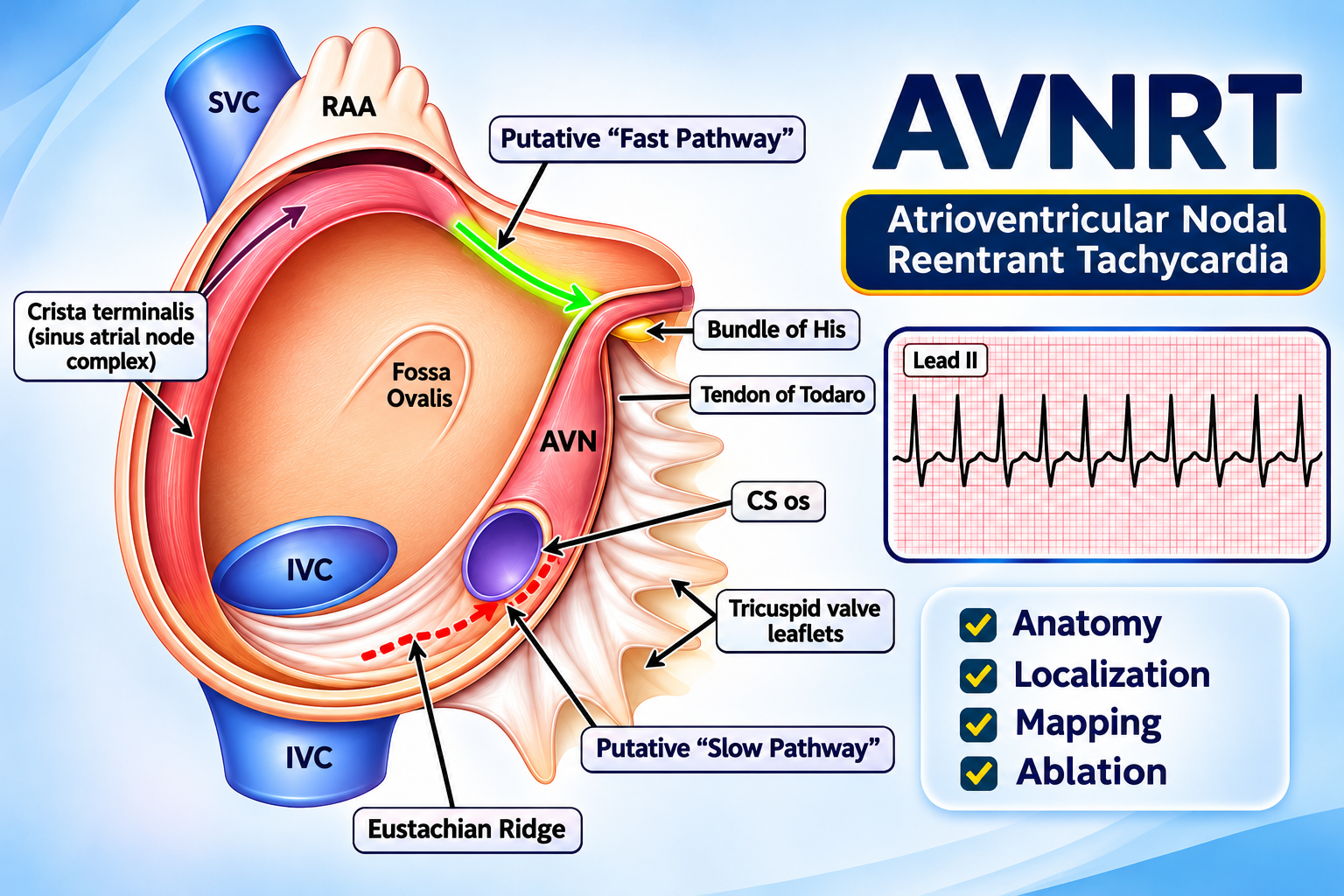
AVNRT- Mapping & Ablation
AVNRT ablation requires a mechanism-first, anatomy-guided and safety-focused approach, with the primary objective of eliminating the clinical reentrant circuit while preserving normal AV conduction. Confirm AVNRT and distinguish it from AVRT and atrial tachycardia before mapping; an AH jump supports dual AV nodal physiology but neither proves AVNRT nor is essential for diagnosis. Understand the triangle of Koch, identify the His bundle as the principal safety landmark, and target the conventional inferior–posterior slow-pathway region near the tricuspid annulus and coronary sinus ostium. Successful localization requires agreement between anatomy, electrograms and catheter stability: a ventricular-dominant A/V electrogram and slow-pathway-type potential may support the target, but neither is mandatory or an absolute RF trigger. In typical AVNRT, do not chase the earliest retrograde atrial activation, which often represents the fast-pathway exit and may lead dangerously close to the compact AV node. Deliver controlled RF only from a stable, anatomically appropriate site, preferably in sinus rhythm when feasible, while continuously monitoring junctional rhythm, AV and VA conduction, surface ECG and impedance. Junctional rhythm is a useful marker of tissue engagement, not proof of success; rapid junctional rhythm, new VA block, PR/AH prolongation or any unexpected conduction change requires immediate cessation of RF and reassessment. The endpoint is noninducibility of clinical AVNRT with preservation of AV conduction, not complete elimination of dual AV nodal physiology: a residual AH jump or isolated echo beat may be acceptable, whereas persistent inducible AVNRT requires reassessment and targeted remapping. Reproduce the original induction conditions, including isoproterenol when appropriate, and individualize the strategy in patients with baseline conduction disease or atypical AVNRT; consider cryoablation, 3D mapping or alternative CS-related/left-sided approaches when clinically justified. Golden principle: Diagnose → Localize → Confirm → Ablate → Monitor → Rechallenge → Stop when clinical reentry is eliminated safely.
1 topic →